
Giotto di Bondone was one of the greatest innovators in the history of art. He enjoyed enormous esteem already in his own time and was the first to completely revolutionise the painting style, giving figures back their volume, depth and sense of space.
Considered by some the forerunner of the Renaissance, the works of Giotto still never cease to move us.
When you think of Giotto, it’s almost inevitable to refer to the wonderful masterpieces made in the city of Florence. Besides the famous bell tower of Giotto, the city holds the beautiful Crucifix of Santa Maria Novella and the frescoes of Santa Croce. His Ognissanti Madonna, meanwhile, opens the route through the Uffizi Gallery, hung beside those of Cimabue and Duccio.
But Giotto’s fame was such that he worked across almost all of Italy. If you haven’t already, I absolutely recommend seeing at least once the fabulous frescoes of the Basilica of Assisi or in the Scrovegni Chapel in Padua.
Did you know Giotto even worked in Naples?
Although only a few fragments of his work remain today, we know that, summoned by King Robert of Anjou, he took part in the works at the Maschio Angioino and the convent of Santa Chiara. And his fame was such that even Dante Alighieri mentions him in Canto XI of Purgatory, as the painter who had “taken the cry” from Cimabue.
OK, but why is Giotto so important?
Giotto was an extraordinary artist and a great innovator of Italian painting. Just as Arnolfo di Cambio had been able to revolutionise the art of sculpture, with his intuitions Giotto innovated the field of painting by giving scenes back their depth and three-dimensionality (an “intuitive”, empirical spatiality: geometric perspective would arrive only a century later, with Brunelleschi).
Fancy learning a little more, and discovering all the most important curiosities and facts about this artist?
Let’s go!
Art before Giotto
Before Giotto, artistic production was mainly influenced by Byzantine art, with hieratic (that is, static, motionless) figures on a golden background. This was a way, as simple as it was effective, of representing the saints’ complete detachment from human reality.
Have you ever looked, for example, at the mosaics of Ravenna?
If you’ve had the chance to visit the Basilica of San Vitale, you’ll have noticed that the mosaics are completely devoid of depth: the figures all sit on exactly the same plane.
During the Middle Ages, in fact, the artistic language had changed compared to Roman art. The most important thing for medieval artists was to convey a message in the simplest possible way, so that everyone could understand it. Compositions were simplified to the utmost, abandoning portraiture and introducing figures with very specific attributes.
And what does Giotto have to do with all this?
Well, with Giotto a real revolution in painting begins.
Giotto, while making some mistakes, tried to make his figures true, three-dimensional, alive. He paid the greatest attention to detail, above all to expressions. He minutely studied movement, how figures are placed and present in space.
In short, the figures in the works of Giotto have emotions; they are caught in different poses and situations, both in everyday scenes and in those of miracles and extraordinary events.
But his revolution wasn’t only in this aspect.


The study of anatomy
Anatomy in the Middle Ages was not studied in much depth. The rejection of physicality that we see in medieval art is also a sign of a conception of the body different from the one we have today.
The medieval world and its spirituality are well represented by an art bent on abstraction and on emphasising the differences between the material world and the spiritual one.
With Giotto, instead, a different kind of research emerges, one that was just beginning in that period.
Here’s an example of this revolution!
In every art history book there’s the comparison between Giotto’s crucifix and that of his master Cimabue. Both works are in Florence and are about 20 years apart, but the differences are striking. Cimabue’s crucifix is in Santa Croce and dates to around 1280. The other, by his pupil Giotto, is in Santa Maria Novella and was made between 1296 and 1300.
Are they really so different?
Looking at them, you can see how, in Cimabue’s work, Christ is arched in a completely unnatural way. What’s more, the abdomen, ribs and arm muscles aren’t realistic at all. In Giotto, instead, the weight of the body is supported by the legs, the pose is natural and true, and the anatomy is given by shading.
Are you starting to understand the revolutionary scope of the works of Giotto?

Conveying emotions
Giotto di Bondone was a great observer of reality: his figures in fact appear very alive, also because they’re highly expressive. The gestures, the movements in which they’re portrayed, but also their faces, all show a very realistic, human vividness. The figures, from the distant and static ones we see in the works of his predecessors, finally come back to life.
You can see it very well in the Lamentation of Christ in the Scrovegni Chapel in Padua.
Look at how the angels despair, at the Magdalene’s tears, the desolation of Saint John flinging out his arms, the Madonna’s contorted face.
Did you notice the group of women on the right?
Each one has a different position of the hands, a different expression on her face. Everyone has a different emotional reaction to the tragedy they’re witnessing.
All the movement of the work of Giotto converges towards Christ’s lifeless body. Not even the profile of the rock is made by chance, but leads the gaze towards the two main figures.
Here’s a curiosity!
Even the figures shown from behind and hooded are a typical trait of Giotto. They serve to make the scene appear as if it were unfolding right in front of us, and to make the viewer identify with the composition.

Dynamism
If you look below at the Ascension of Christ in Padua, you can certainly notice the great dynamism of the scene.
The Saviour stretches towards the sky, and it seems the clouds are carrying him. The composition, meanwhile, appears divided into two parts: the earthly one, where everyone stands still in prayer, and the celestial one, where the Saviour ascends towards heaven, surrounded by angels.
You can almost catch the movement!
The same happens in the scene at Assisi in which Saint Francis renounces his worldly goods. The father, a rich merchant, is held back by a man because he seems about to slap his son, whose gesture he cannot understand.
After all, what would your father do if you suddenly stripped in the street, saying you no longer wanted to own anything material?
The scene and the characters’ feelings are rendered superbly by Giotto: the disbelief of the bystanders, Francis’s spirituality and his father’s anger.
A real revolution compared to the past, isn’t it?


Architecture in Giotto
In Giotto, architecture is not yet rendered perfectly, because the study of perspective had not yet been developed. For this reason, the structures in his works often turn out to be fanciful.
Despite this, his observation of reality and his attempts at spatial rendering are evident.
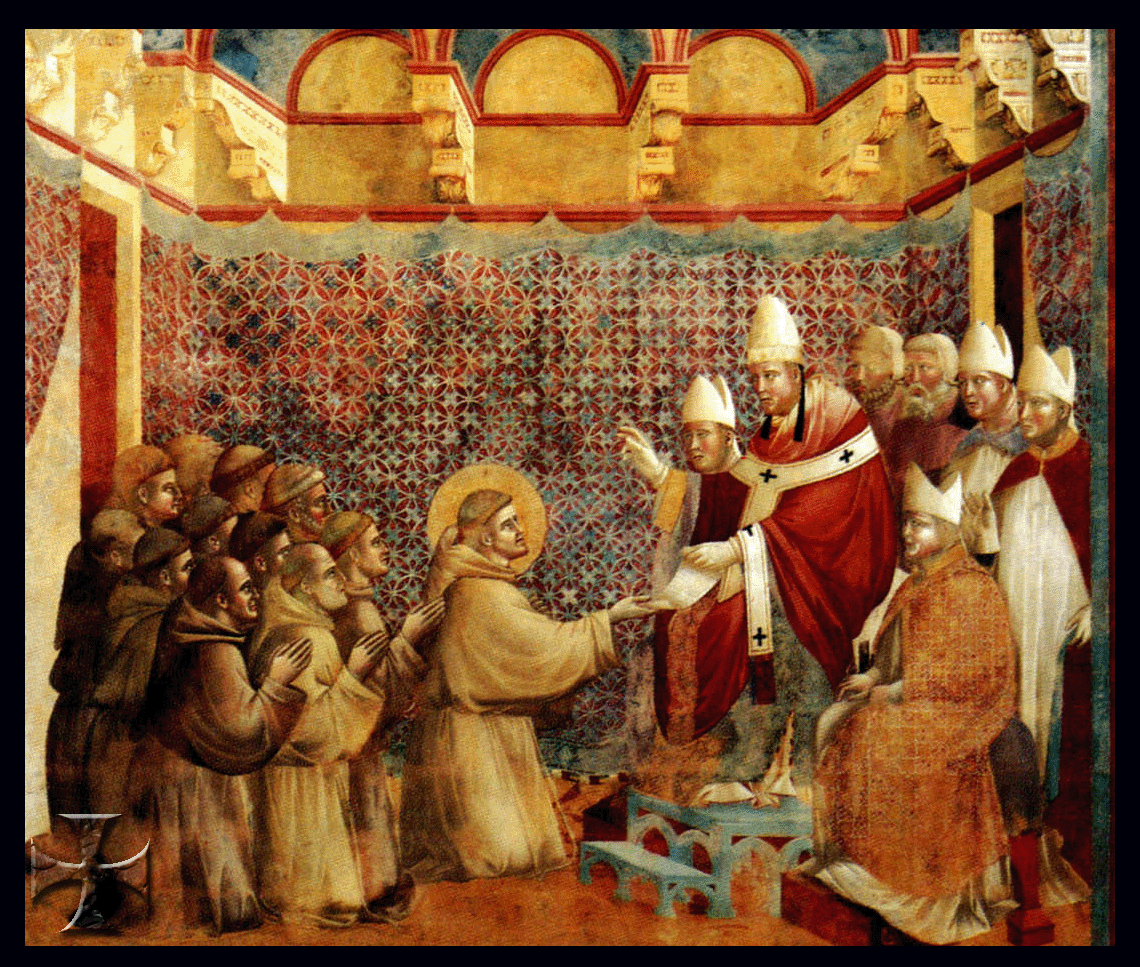
Look, for example, at the steps of the Pope’s throne, or the ceiling beams in this scene where the Pope approves the Franciscan rule, painted in the Upper Basilica of Assisi. The depth of the work of Giotto, though not perfect, is very clear!
Oh, and don’t forget that Giotto was also an architect: it’s to him that we owe the design of the incredible bell tower of Santa Maria del Fiore in Florence. Appointed master of works (capomaestro) of the Cathedral in 1334, he only lived to see its base built: on his death the works continued with Andrea Pisano and were completed by Francesco Talenti in 1359. Yet you can still see the master’s hand in the polychromy of the white, red and green marble, and around the base of the tower runs an important cycle of reliefs depicting the arts and crafts. You climb it with the pass for the Florence Duomo complex.
Even if it’s not possible to attribute these, and other sculptures, to Giotto, we can nonetheless see his genius behind the overall design of this splendid bell tower.
The life of Giotto di Bondone
Having lived in such a distant era, we know practically nothing of the life of Giotto, so much so that some aspects are by now shrouded in legend. What we do know is that he was considered by his contemporaries the best painter of his time.
He was probably born around 1267 at Vespignano, in Tuscany.
He trained between Florence and Rome and had Cimabue as his master. Among the famous anecdotes, it’s told that Cimabue noticed Giotto, a young shepherd, making a perfect drawing of one of his sheep, and so took him into his workshop.
Another version has the young Giotto able to trace a perfect circle without the aid of a compass, to prove his artistic skill. A last story has the young pupil painting a fly that the master tried in vain to shoo away.
Beyond the legends, Giotto worked in Rome, Rimini, Florence, Milan, Naples, Padua and Bologna. Among his masterpieces are the fresco cycles of the Basilica of Saint Francis in Assisi, the Scrovegni Chapel in Padua, and the Peruzzi and Bardi Chapels in Florence. We also have beautiful crucifixes and polyptychs, including the Stefaneschi Polyptych at the Vatican Museums. In Bologna, on the other hand, one of his very few signed works survives, the Bologna Polyptych, which carries the inscription OPUS MAGISTRI IOCTI DE FLORENTIA on the step of the throne and is seen today at the Pinacoteca Nazionale. Almost nothing survives of what he painted in Naples, and the little the fire of 1943 spared is to be looked for in the Choir of the Poor Clares at Santa Chiara.
Giotto drew inspiration from the Roman works of Jacopo Torriti, Filippo Rusuti and Pietro Cavallini, also avant-garde for their time. He nonetheless remained the most illustrious innovator of medieval painting. His genius and the revolution he took part in are comparable only with those of his contemporaries Arnolfo di Cambio and Giovanni Pisano in sculpture.
He was so original that the history of Renaissance art is usually made to begin precisely with him and his work. His teachings so deeply influenced the art of later generations that he is considered the first of the great masters of the history of art.
He died at the height of his fame, on 8 January 1337, in Florence.
His solemn funeral was paid for at the expense of the city of Florence.


Ipse dixit
Here are some words of praise for the famous artist from his contemporaries (Dante) and from one of the first art historians, who lived about a hundred years later:
- “Cimabue believed he held the field in painting, and now Giotto has the cry, so that the other’s fame is dimmed.” (Dante, in the original: “Credette Cimabue ne la pittura / tener lo campo, e ora ha Giotto il grido, / sì che la fama di colui è scura”)
- “Giotto turned the art of painting from Greek [Byzantine] into Latin and brought it up to date; and he had the most accomplished art anyone ever had.” (Cennino Cennini)

Where to see Giotto’s works
Giotto worked across half of Italy, and even today you can follow his trail from city to city:
- In Padua, the Scrovegni Chapel: his absolute masterpiece, a fresco cycle that takes your breath away. It can only be visited by booking, with capped 15-minute time slots (preceded by a climate-controlled room that protects the frescoes).
- In Assisi, the Stories of Saint Francis in the Upper Basilica.
- In Florence, the Crucifix of Santa Maria Novella, the Bardi and Peruzzi Chapels in Santa Croce, the Ognissanti Madonna at the Uffizi and the famous bell tower beside the Cathedral.
- At the Vatican Museums, the Stefaneschi Polyptych.
If you’re planning a trip to the Veneto, book your Scrovegni Chapel ticket well in advance: the slots sell out weeks ahead, and seeing them in person is an experience worth the journey.
And you, have you already had the good fortune to stand in front of a fresco by Giotto?


