Are you touring Germany and wondering what to see in Dusseldorf in one day?
Let me warn you straight away: if you are looking for an intact medieval old town, you have the wrong city. Dusseldorf lost most of its monuments under the bombing of the Second World War, and what you see today is largely rebuilt.
So there is nothing to see?
Quite the opposite, and this is the thing I only understood once I got there: Dusseldorf stopped competing on its past and won on its present. Today it is one of the European capitals of contemporary art and architecture, it holds one of the most important collections of twentieth-century art in Germany, and it has turned an industrial harbour into a park of star architects.
I arrived by train, almost by accident, with one day to spend. In this post I’ll tell you what to see in Dusseldorf in one day, putting things in the right order: art first, beer second.
Let’s go!
1 – The Rheinturm, the highest point in the city
The first thing to do when you arrive is go up, because that is how you immediately understand how the city is put together.
Dusseldorf’s tower is called the Rheinturm (Rhine Tower) and it is not, as you often read, a generic “Fernsehturm”: it is the symbol of the city, built between 1978 and 1982 and raised to 240.50 metres in 2004 with its current antenna. The observation deck sits at 168 metres and gives you a 360-degree view.
The walls are glass and they are tilted: leaning on them genuinely feels like falling into the void. I was brave enough to lie down on the glass for the photo, over to you.
But the best thing about the Rheinturm is not the view.
Look at the shaft of the tower from outside, in the evening. That row of lights is not decoration: it is the “Lichtzeitpegel” by Horst H. Baumann, a light work that functions as a clock. You read the exact time by counting the lamps, and the Guinness Book of Records lists it as the largest decimal clock in the world. An art installation that is also an urban stopwatch, 240 metres tall.
Practical information: adult ticket 10 € (not the 4 € you’ll read in older guides, mine included: that was the price ten years ago), open every day from 10 am to midnight, with a bar and lounge at the top. Always check before you go.

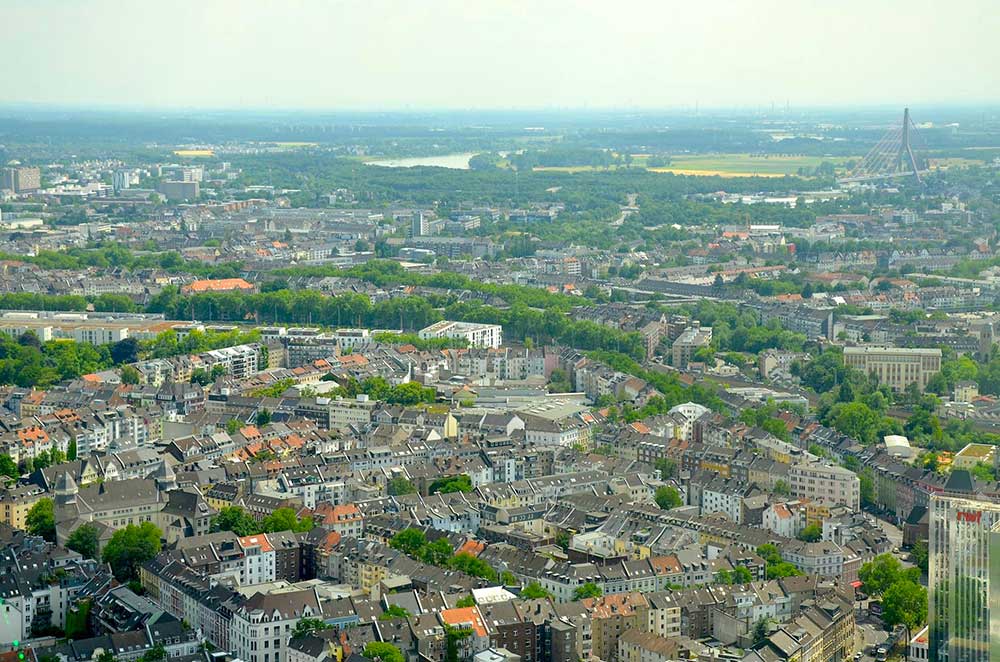
2 – The Gehry buildings at the MedienHafen
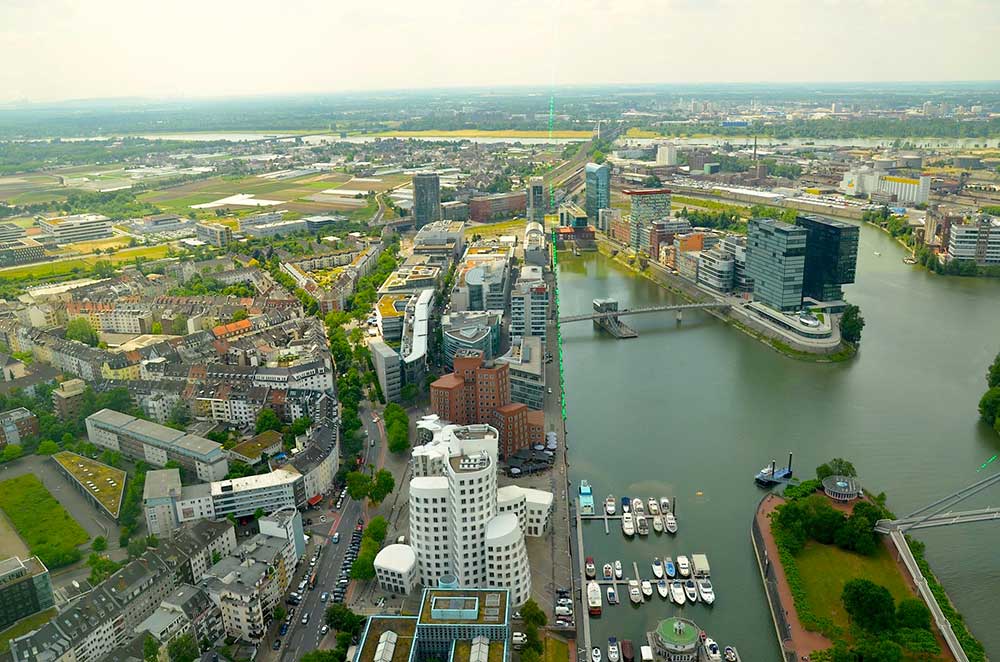
Below the tower opens the MedienHafen, the disused commercial harbour that since the 1990s has become the district of media and signature architecture. You can walk through it for free, and it is the thing that impressed me most in Dusseldorf.
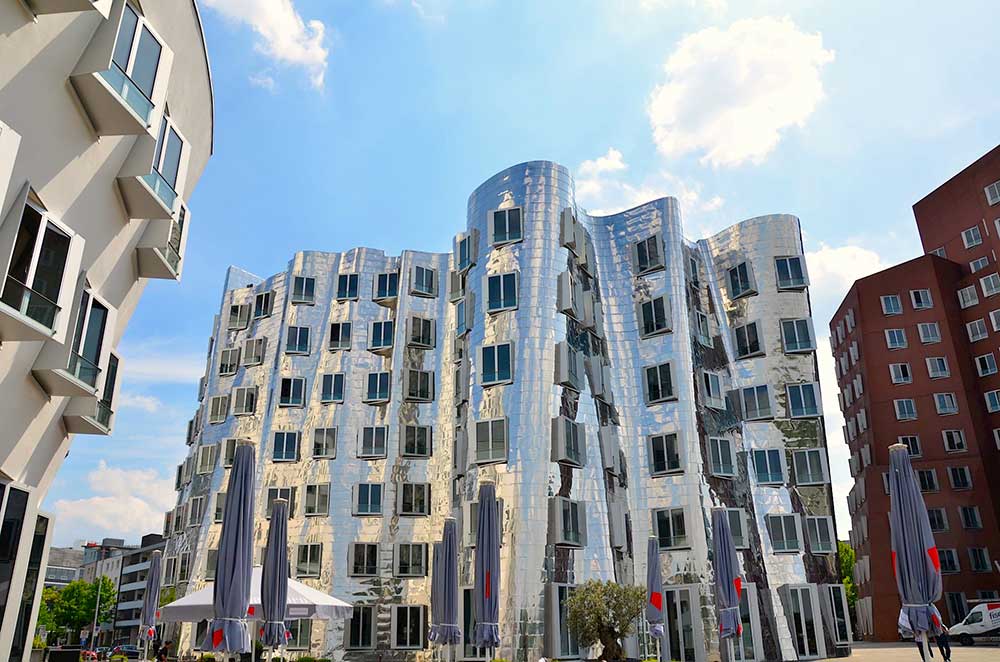
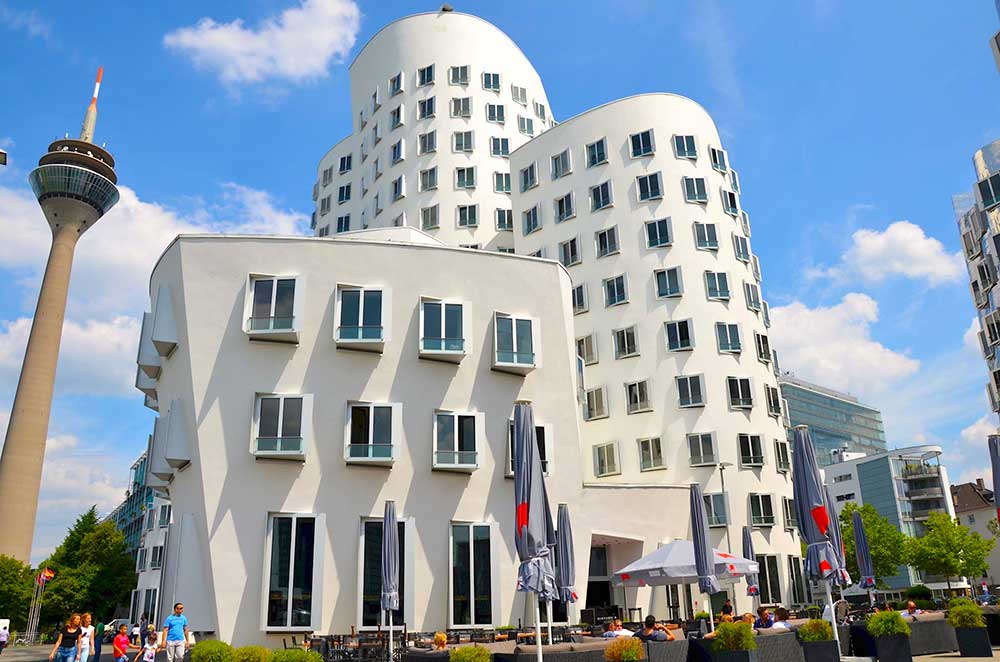
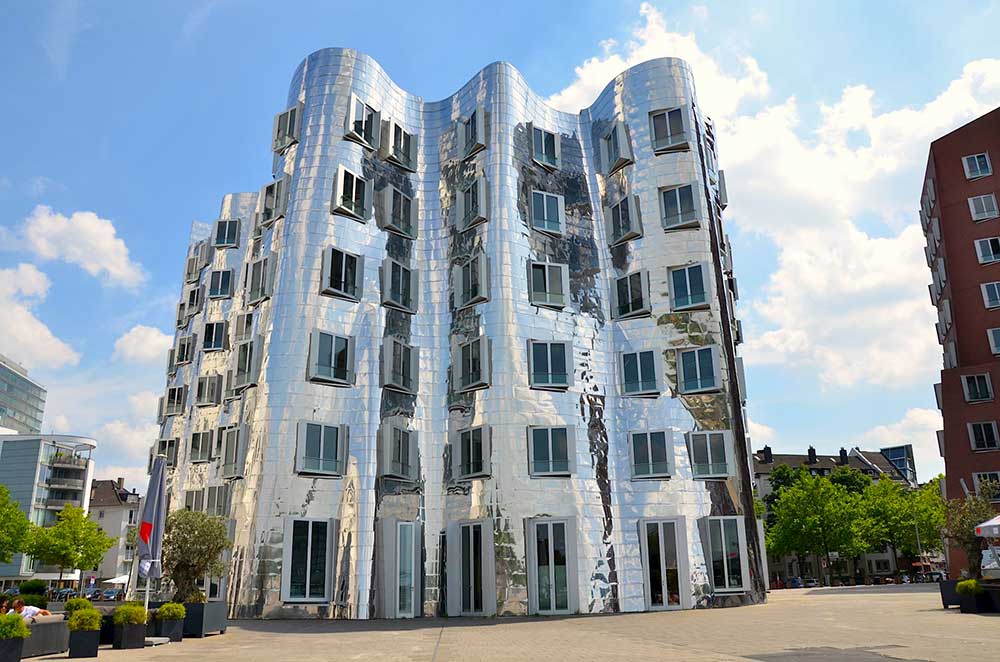
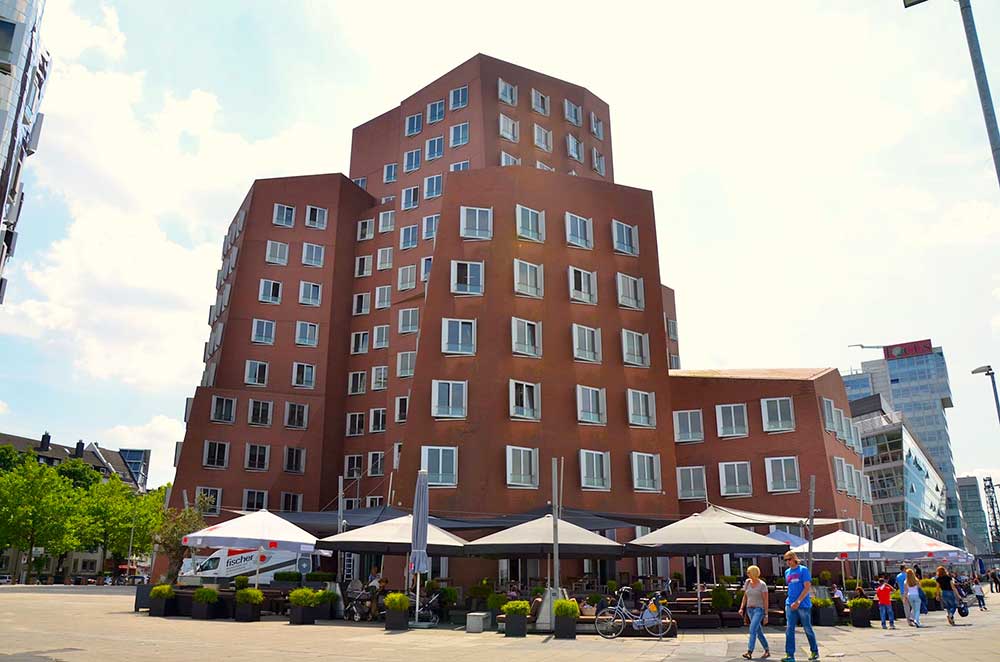
The highlight is Frank Gehry’s Neuer Zollhof: three buildings completed in 1998 and opened on 19 October 1999, forming a single ensemble while being completely different from one another. Look at them one at a time, because the game is all in the materials:
- the building facing the harbour is entirely clad in brick and angularly deformed;
- the middle one has a wavy stainless steel façade, which reflects the other two and the whole sky around;
- the third is in white plaster, with volumes interlocking in large curves.
In Dusseldorf everybody calls them “the family”: the middle one is said to be the child, reflecting and reproducing its parents in its mirrors, the dark angular one the father and the white sinuous one the mother. It is a reading that circulates in the city and that works beautifully when you are standing in front of them, but it is popular interpretation, not a statement by Gehry: the official sources only speak of a “trinity” of sculptural volumes. Take it for what it is, a good story.
Do not stop at the Gehry buildings: the MedienHafen also has Will Alsop’s Colorium, the tower of coloured glass tiles, and projects by Steven Holl, David Chipperfield and Joe Coenen. It is an open-air catalogue of contemporary architecture, and it takes an hour’s walk along the water.
3 – The Flossis: the story of an artwork that is no longer there
And here I have to correct myself, because when I wrote the first version of this post the Flossis were still up.
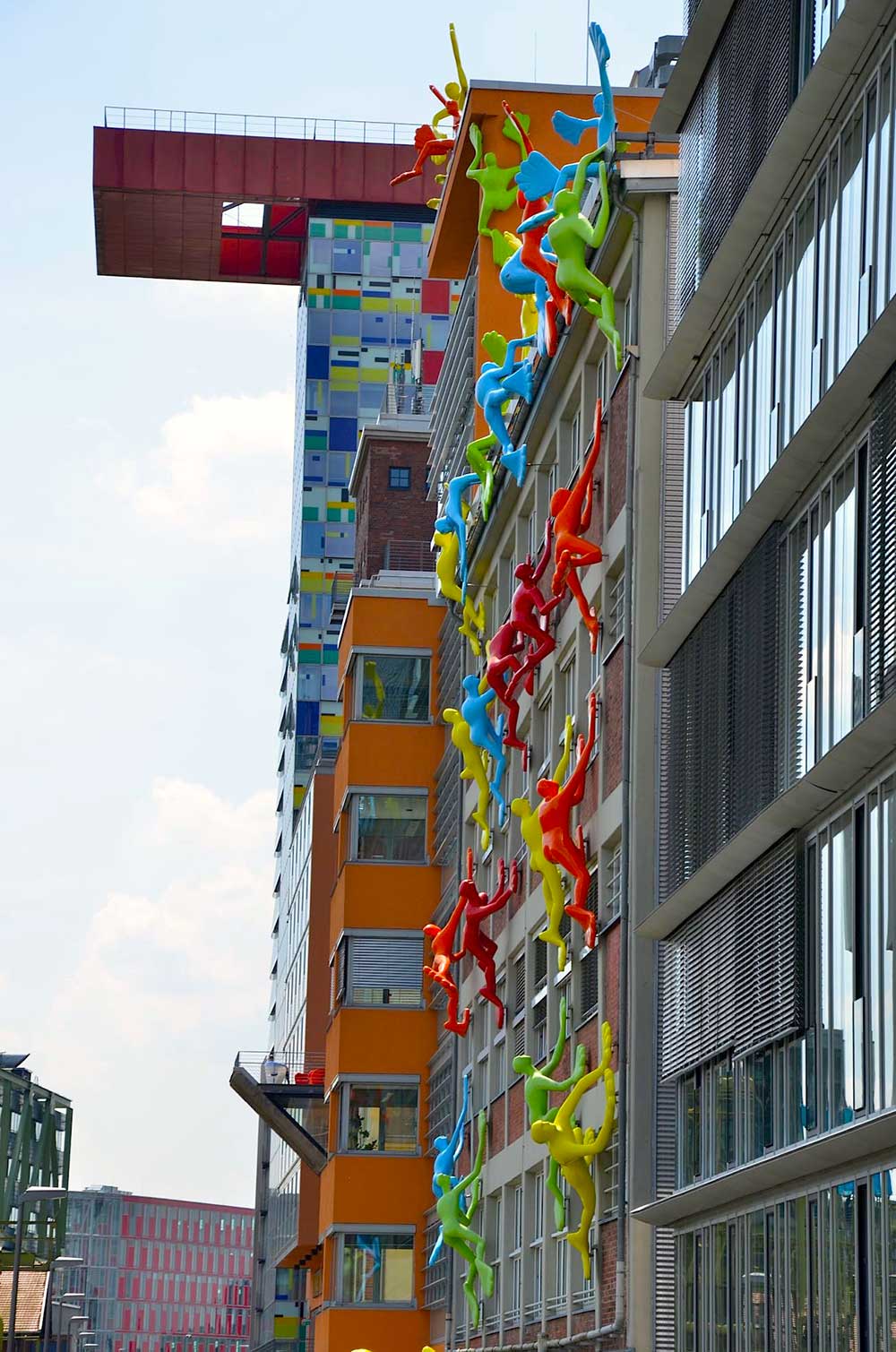
The Flossis were twenty-four brightly coloured human figures that looked as though they were climbing the façade of a harbour warehouse, the Roggendorf-Haus on Speditionstraße, plus five more on the building next door. They were created in 1998 by the artist rosalie (the pen name of Gudrun Müller), and not for that building: they were born as a temporary installation for the opening of the Deutsches Kunststoff Museum, the German plastics museum, at the Ehrenhof. They arrived on the Roggendorf-Haus in 2002, and became one of the most photographed images in the city.
On 14 May 2018 they were taken down.
The reason is almost ironic, and it contradicts what I had written myself. In the first version of this post I explained that the Flossis were made “with special resins able to withstand low temperatures”. They were not: they were plastic designed for a museum, not for spending twenty years outdoors. Weather, corrosion and water damage had degraded them to the point of becoming a hazard to people walking underneath, and the city removed them for safety reasons.
They have been in storage ever since. As I update this post they have not been restored or put back, and their future is uncertain.
I am telling you all this for two reasons. The first is practical: do not go to the MedienHafen expecting to see them, because they are not there, and you will still find dozens of articles (mine included) promising them to you. The second is that it is a fine lesson in what public art means: a work born to spend a few months indoors ended up defining the skyline of a district for sixteen years, and then the material presented the bill.
The photo below is, by now, a document.
4 – K20 and K21: the real reason to come to Dusseldorf
If you are on this blog, this is the chapter that matters to you, and it was entirely missing from the first version of this post. Let me make up for it.
The Kunstsammlung Nordrhein-Westfalen is the art collection of the state of North Rhine-Westphalia, and it is visited across two venues whose names say it all:
- K20 on Grabbeplatz, devoted to the twentieth century, with over 180 masterworks of classical modernism and post-war art: Paul Klee, Matisse, Picasso, Pollock, Warhol, and then the local Germans, Joseph Beuys and Gerhard Richter;
- K21 in the Ständehaus, the former regional parliament, devoted to contemporary art and to big temporary exhibitions, with installations that make use of the architecture of the building.
Let me add a piece of context that makes Dusseldorf even more interesting for anyone who loves twentieth-century art: this is home to the Kunstakademie, the academy where Beuys taught and where the so-called Dusseldorf school of photography was formed (Bernd and Hilla Becher and their students, among them Andreas Gursky and Thomas Struth). This city produced an enormous share of contemporary German art, it did not merely buy it.
Tickets cost around ten euros per venue, with differences between K20 and K21 and between collection and exhibitions: check the website before you go, because they change with whatever is on.
5 – The Kunstpalast, reopened in 2023
In the first version of this post I wrote that I had not yet visited the Kunstpalast. Everything has changed since then, and this time the news is good.
The museum closed for three years of works and reopened on 21 November 2023, completely rethought. It displays around 800 works chosen from the 130,000 in its collections, spanning eleven centuries: painting, sculpture, applied arts and one of the most important glass collections in Europe. The new layout mixes the periods instead of separating them, which is a bold choice and, for me, a successful one.
In the same Ehrenhof complex there is also the NRW-Forum, devoted to photography, design and pop culture, and it is exactly the place the Flossis were created for.
6 – The Altstadt and “the longest bar in the world”
Now the eating and drinking part, and in Dusseldorf that is not a footnote.
Despite the bombing, a portion of the old town survived: it is the Altstadt, a grid of lanes between the Rhine and the Königsallee. Here stands one of the few surviving historic buildings, the Rathaus (the town hall) on the Marktplatz, whose oldest core goes back to 1573: what you see is in fact a set of five building blocks put up over the centuries down to the 1800s, closing the square. At the centre is the baroque equestrian statue of 1711 of Johann Wilhelm von der Pfalz, whom the people of Dusseldorf affectionately call Jan Wellem.
But the Altstadt is famous for another reason. Within a few hundred metres there are over three hundred bars, which is how it earned the title of “längste Theke der Welt”, the longest bar counter in the world.
What you drink here is Altbier, the beer of Dusseldorf: copper-dark, bitter, and top-fermented (that is what “alt”, “old”, refers to, the method used before lagers arrived). It is served in small 0.25 glasses and the waiters of the historic breweries, the Köbes, will keep putting a fresh one in front of you until you place your coaster on top of the glass. The cult breweries are Uerige, Füchschen and Schumacher, which brew it in house.
I drank my Altbier in a pub in the centre where the local lads made me try a non-alcoholic short drink called “stress”, so spicy that it took three beers to recover. It works: afterwards, every other problem looks small.
If you are hungry, the right place is Carlsplatz, the covered market in the centre: stalls of cheese, fish, flowers and street food, and you can have an excellent lunch standing up.
7 – Little Tokyo, Japan in Germany
This is the most unexpected thing about Dusseldorf, and it was not in the first version of this post.
Around Immermannstraße, a couple of minutes from the station, there is a genuine Japanese quarter that everyone calls Little Tokyo: signs in Japanese, bookshops, supermarkets, patisseries, and some of the best ramen in Europe.
This is not a tourist operation: around 15,000 Japanese people live in the Dusseldorf area, and it is the largest Japanese community in Germany. It formed from the 1950s and 1960s onwards, when Japanese companies chose the city as their European base for its central position, its closeness to the industrial Ruhr and its links to the major ports.
If you only have one lunch in Dusseldorf, my advice is counterintuitive: eat Japanese, and have the Altbier in the evening.
8 – Where Heinrich Heine was born
One last short stop for literature lovers. At Bolkerstraße 53, right in the Altstadt, Heinrich Heine was born in 1797, the greatest German poet of the nineteenth century after Goethe and one of the freest and most sarcastic spirits of his age.
Since 2006 the building has housed a literature centre, which since 2017 has been called Heine Haus Literaturhaus Düsseldorf and runs readings and talks. Even just walking past is worth the two-minute detour: Heine’s relationship with this city was a complicated one, he left it young and looked at it from a distance all his life.
Practical information for visiting Dusseldorf
Getting there. Dusseldorf has an international airport linked to the centre in about ten minutes by S-Bahn, and it is a major rail hub: the main station is close to the Rheinturm and the Altstadt. I arrived by train, which is extremely convenient because it drops you straight in the city.
How long you need. One day is enough for the Rheinturm, MedienHafen, Altstadt and one museum. If you want to do K20 and K21, or add the Kunstpalast, you need two days. The city is compact and public transport works perfectly.
The DüsseldorfCard. It only makes sense if you do the museums, and that should be said plainly. The basic 24-hour version costs 13.90 € (not the 10 € of a few years ago) and includes unlimited city transport plus discounts of up to 100% on more than eighty offers; there are also 48, 72 and 96-hour versions and the “Plus” and group variants. If you are just passing through for a walk by the harbour, forget it: the MedienHafen, the Altstadt and the riverside cost nothing. If instead your day involves two museums and some travelling around, here you can find the DüsseldorfCard and it pays for itself.
When to go. Winter is cold and damp, so the best season is between spring and early autumn, when the riverside and the MedienHafen terraces fill up with people. If you happen to be there at Carnival, be aware that here it is a serious business (and a rival to Cologne’s).
What I still have to see. Benrath Palace, the pink rococo residence outside the city with its park, and Schloss Jägerhof. I have not made it there yet: I’ll update you after the next trip.
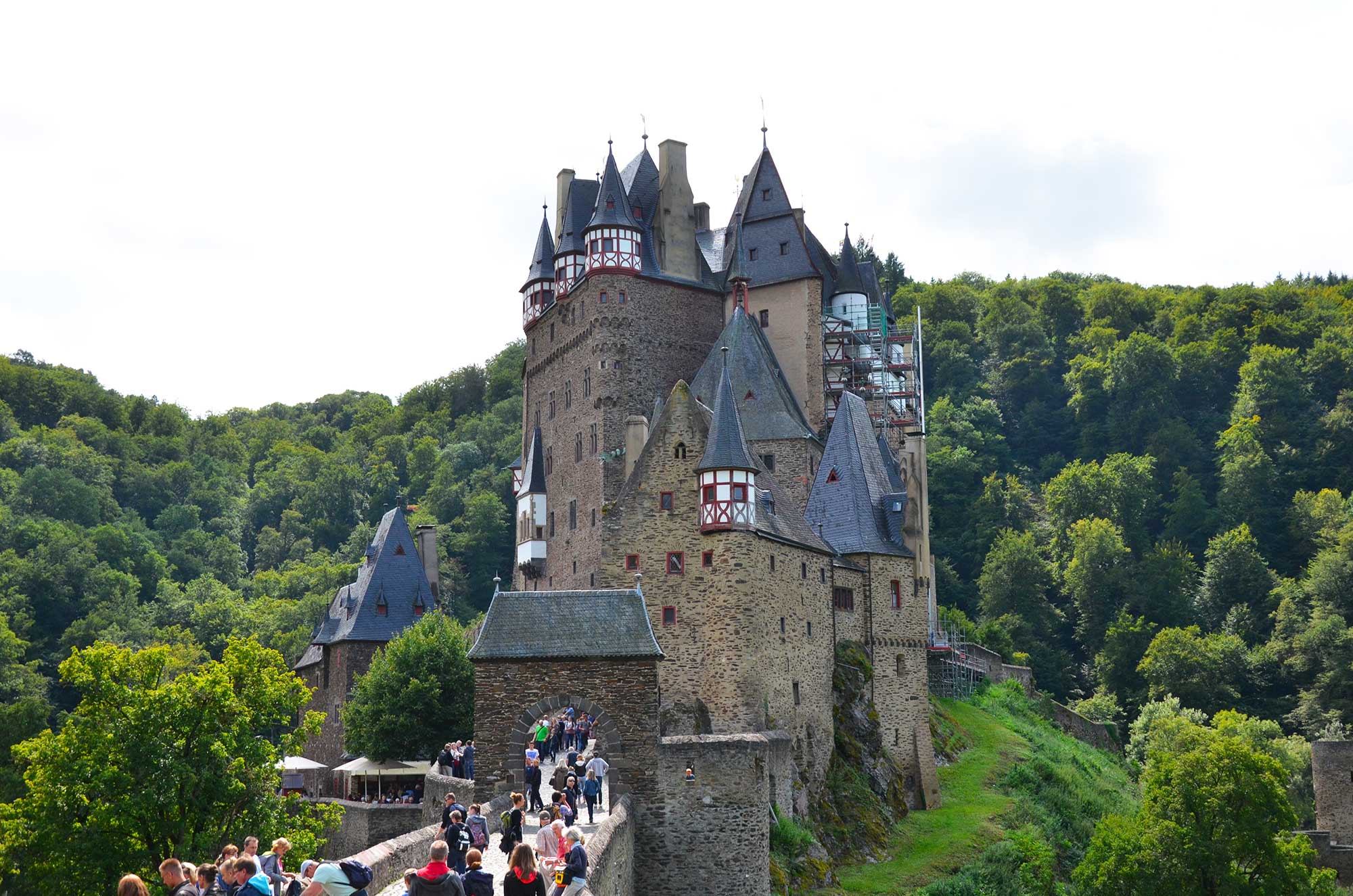
Dusseldorf sits at the centre of one of the densest areas of good things in Europe, and the smartest move is to use it as a base. Twenty minutes away by train is Cologne with its cathedral and its five unmissable museums; a little further out Aachen with Charlemagne’s palatine chapel, and on the Moselle Eltz Castle.
And you, does Dusseldorf appeal to you more for the contemporary art or for the longest bar in the world?