

Are you traveling to Madrid and would like to discover some of the city’s most interesting museums? Would you like to know whether the Reina Sofia Museum is worth visiting, and maybe get familiar with some of its most important works before you go in?
If you love contemporary art, this is exactly the museum for you.
The Museo Reina Sofia is not only one of the most important museums in Madrid, but also the place that brings together some of the most significant works from the 20th century to the present day. For this reason, inside you will mainly find masterpieces by Picasso, Miró and Dalí, but paintings are not the only thing that will surprise you.
The building itself has a very interesting history.
Before becoming a museum, the Reina Sofia in Madrid was a hospital for more than two centuries. The original building, known as the Hospital General de San Carlos, was designed in the 18th century by the Italian architect Francesco Sabatini at the request of King Charles III, and remained in use as a hospital until 1965. After a long period of abandonment, the building was converted and inaugurated as a museum in 1992, named after Queen Sofía of Spain. Later, in 2005, the French architect Jean Nouvel designed the modern extension with its distinctive red volumes: here you will find the auditorium, the large library and new exhibition rooms.
If you would like to learn more about modern and contemporary art in Madrid, inside Retiro Park you will find two satellite venues of the museum, the Palacio de Velázquez and the Palacio de Cristal, which often host very interesting temporary exhibitions.
But what should you see at the Reina Sofia?
Just like the statue of Marcus Aurelius at the Capitoline Museums, the Sistine Chapel at the Vatican Museums or the Mona Lisa at the Louvre, the Reina Sofia also has its most important work. I am, of course, talking about the beautiful Guernica, Pablo Picasso’s masterpiece, first shown at the Spanish Pavilion of the 1937 International Exposition in Paris.
Before telling you about the 9 unmissable works at the Reina Sofia, if you are already in Madrid or are planning a trip to the Spanish capital, I recommend buying your entrance ticket in advance to avoid the long queues at the entrance and save precious time.
But enough talking. Below I’ll tell you what to see at the Reina Sofia and the 9 works I liked the most.
Let’s get started!
Table of contents
1 – Picasso’s Guernica at the Reina Sofia Museum
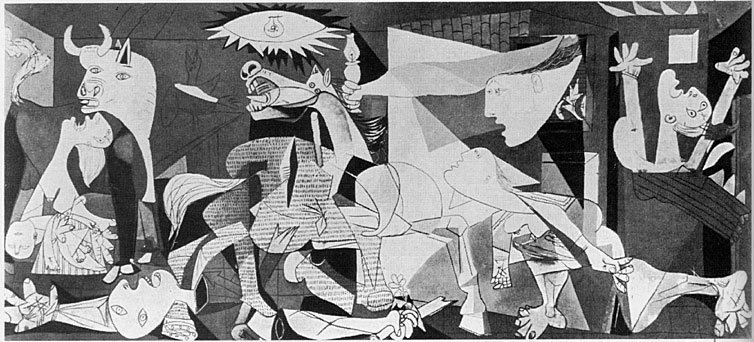
The most famous work in the Museo Reina Sofia is undoubtedly Picasso’s monumental painting “Guernica”. This enormous canvas, measuring 3.49 by 7.77 meters, is probably the largest painting you will ever see in person. You have surely already seen it in a schoolbook or in some reproduction, but I can assure you that standing in front of it is a truly powerful experience.
Guernica was painted by Picasso in 1937 on commission from the Spanish Republican government for the International Exposition in Paris, and today it occupies the entire Room 206 of the Museo Reina Sofia, on the second floor of the Sabatini building. Despite the size of the room, be prepared to battle with dozens of heads and smartphones that will make it rather difficult to see the painting properly: it is one of the most photographed works in the world.
But what does Guernica represent?
This painting is a true political and social manifesto against war, against fascist regimes and, at the same time, a desperate cry from all humanity. More specifically, it is a freeze-frame of the bombing of the Basque town of Guernica, which took place on April 26, 1937, during the Spanish Civil War. On that occasion, Italy and Germany supported Franco’s forces against the Republicans by sending military aid, including the infamous German Condor Legion and the Italian Aviazione Legionaria, which together razed the town to the ground.
The event caused enormous outrage around the world, both because carpet bombing non-military towns from the air was something completely new at the time, and because Guernica was not in a war zone: it was market day, and the victims were mainly women, elderly people and children.
In representing this tragedy, Picasso chose to use only dark shades, blacks, greys and whites, a deliberate reference to the newspaper photographs through which the world learned about the massacre. The figures are fragmented, desperate and screaming. Even the animals, such as the bull and the horse, seem to be in agony.
Fire, destroyed buildings, violence, fury and fear: all of this will hit you with incredible force as you look at Picasso’s Guernica.
Yet amid all these horrors, the artist does not forget to leave a small message of hope: if you look carefully, you can spot a flower growing from a broken sword, held in the hand of the fallen warrior in the foreground. Picasso’s intention was to make world powers reflect on the atrocity of war, so that something like this would never happen again.
In short, Picasso’s wish for the future of humanity.
A curiosity before moving on: Guernica has had a turbulent history. After the Paris Exposition, the painting traveled around the world for years as anti-Franco propaganda and was later kept at MoMA in New York. Picasso had stated that the work could return to Spain only after the fall of the regime and the restoration of democratic freedoms. Guernica finally arrived in Madrid in 1981, six years after Franco’s death, and has been on display at the Reina Sofia since 1992.
2 – Dalí’s Girl at the Window
I have a great passion for Surrealism and for Salvador Dalí, whom I got to know even better while visiting the beautiful Espace Dalí in Montmartre. At the Reina Sofia Museum there are several masterpieces by the Catalan artist, but “Girl at the Window” — in Spanish, Muchacha en la ventana — struck me in a very special way.
The painting was made in 1925 at the family’s seaside house in Cadaqués, on the Costa Brava. The model is his sister Ana María, who was 17 at the time and was one of the most recurring female figures in the artist’s early works, before Gala entered his life. The young woman is shown from behind as she looks out at the landscape beyond the window: the dominant color is blue, echoed in the girl’s dress, the sea and the curtains moving lightly in the breeze.
The contrast between interior and exterior, the perspective lines of the parquet floor and the open window draw your gaze beyond the frame, toward the boats and the landscape of the bay in the background. The feeling is almost that of being in the room with Dalí and his sister, admiring the view. You can almost hear the muffled sounds coming from the beach, while inside the house there is the lazy silence of a summer day.
If you pay attention to the details, you will notice several interesting things.
Besides being a classic “painting within a painting”, on the right-hand shutter of the window you can glimpse another reflection of the landscape, framed between the wooden boards. It is a small visual game that multiplies the perspective and already hints, in a still “quiet” way, at the artist’s future taste for double layers of meaning, which would become a key feature of his Surrealist production.
Used as I was to Dalí’s more “eccentric” works, I truly did not expect to find such a delicate and poetic painting at the Reina Sofia. This is in fact one of the artist’s early works, made when he was just 21 and still attending the Real Academia de San Fernando in Madrid. At this stage, Dalí was strongly influenced by Vermeer’s realism, by Velázquez and by the movements of Catalan Noucentisme: Surrealism would come only a few years later, around 1929.
A curiosity: the relationship between Salvador and his sister Ana María deteriorated deeply precisely because of Gala’s arrival in the artist’s life. Years later, in 1949, Ana María published a memoir entitled “Salvador Dalí as Seen by His Sister”, in which she described her brother before his Surrealist “transformation”. Dalí never forgave her for it.

3 – Man Ray: Indestructible Object
A metronome, the photograph of an eye and a decidedly bizarre title: here is a work in full Dadaist style.
This small sculpture belongs to the world of “ready-mades”, the revolutionary artistic category introduced by Marcel Duchamp, in which everyday objects “become” works of art because the artist charges them with a new meaning, changing their role and context.
The work was created by Man Ray in 1923 under the title “Object to Be Destroyed”.
The artist had conceived it to mark the rhythm of his brushstrokes to the beat of the metronome, just as musicians do. Years later, after the end of his troubled relationship with photographer and model Lee Miller, Man Ray cut out a photograph of his former lover’s eye and attached it to the instrument’s pendulum: a sort of artistic revenge for a lost love.
Man Ray even left precise instructions for making and destroying the work:
“Cut out the eye from a photograph of a person who has been loved but is no longer seen. Attach the eye to the pendulum of a metronome and adjust the weight according to the desired rhythm. Keep going until you can bear it no longer. With a well-aimed hammer blow, try to destroy the whole thing in one stroke.”
And here comes the most curious part of the story.
In 1957, during an exhibition in Paris, a group of young protesters decided to take the artist’s instructions literally and destroyed the work with gunshots. Far from getting angry, Man Ray collected the insurance payout and used the money to reconstruct the piece, this time renaming it “Indestructible Object”. A brilliant change of title: as if to say that art does not live only in the physical object, but is something immortal that cannot truly be destroyed.
From that moment on, Man Ray made several authorized replicas, and that is why today you can find versions of this work in various museums around the world, from MoMA in New York to Tate in London, all the way to the Reina Sofia in Madrid.
A century later, this small metronome still makes us reflect on the role of art, the artist and the avant-gardes of the 20th century.

4 – Dalí’s The Great Masturbator
As you can easily guess from the title, in this work Dalí places the emphasis on eroticism and sensuality. The phallic references are evident in the male bust in the upper right, but also in the pistil of the calla lily and in the “erect” tongue of the lion in the foreground.
But what exactly does this painting represent?
You may not have noticed it, but the yellow figure in the foreground is nothing other than a self-portrait of the artist himself, positioned horizontally. It is a profile that Dalí would return to several times in later works, including the famous “Face of the Great Masturbator” and “The Persistence of Memory”. From the mouth of this figure, through a kind of metamorphosis, there seems to emerge the bust of a woman evoking an act of fellatio. The woman is placed directly in front of a man’s genitals, creating a strong ambiguity between the title of the work, which refers to masturbation, and the visual representation, which instead evokes a sexual act between two people. This contrast makes the whole scene even more dreamlike and unsettling.
But there is much more to this painting at the Reina Sofia!
You can in fact notice all the elements that define Dalí’s poetic world: the desert landscapes typical of the Costa Brava of his childhood, the golden rocks of Cap de Creus that you can recognize in the background, and even an early experiment with those “soft structures” that would become his signature in the melting clocks of “The Persistence of Memory” in 1931. The theme of death and decay is also present, highlighted by the decomposing belly of the grasshopper clinging to the artist’s face, covered in ants, recurring symbols of Dalí’s anguish and obsession.
The scene is obviously unreal and nothing is what it seems, but what is most surprising about this work at the Reina Sofia is the great sense of balance and harmony between the elements.
And then there is the story behind the painting, even more fascinating than the image itself.
The woman represented is in fact Gala — born Elena Ivanovna Diakonova — the artist’s muse and future lifelong companion, a crucial figure in his career and success. Dalí painted this work in 1929, immediately after spending the summer in Cadaqués with Gala and her husband, the French Surrealist poet Paul Éluard, together with other members of the Surrealist movement such as René Magritte and Luis Buñuel.
Dalí and Gala felt an immediate and intense attraction, despite the fact that she was ten years older than him and married. That passion soon turned into a relationship made of excess, obsessive love and extreme creativity, lasting 53 years, until Gala’s death in 1982. It is no coincidence that this painting is considered the real turning point in Dalí’s career: the beginning of his more mature Surrealist period and the work in which he exorcised, once and for all, his sexual anxieties in front of the first great love of his life.

5 – Picasso’s Woman in Blue
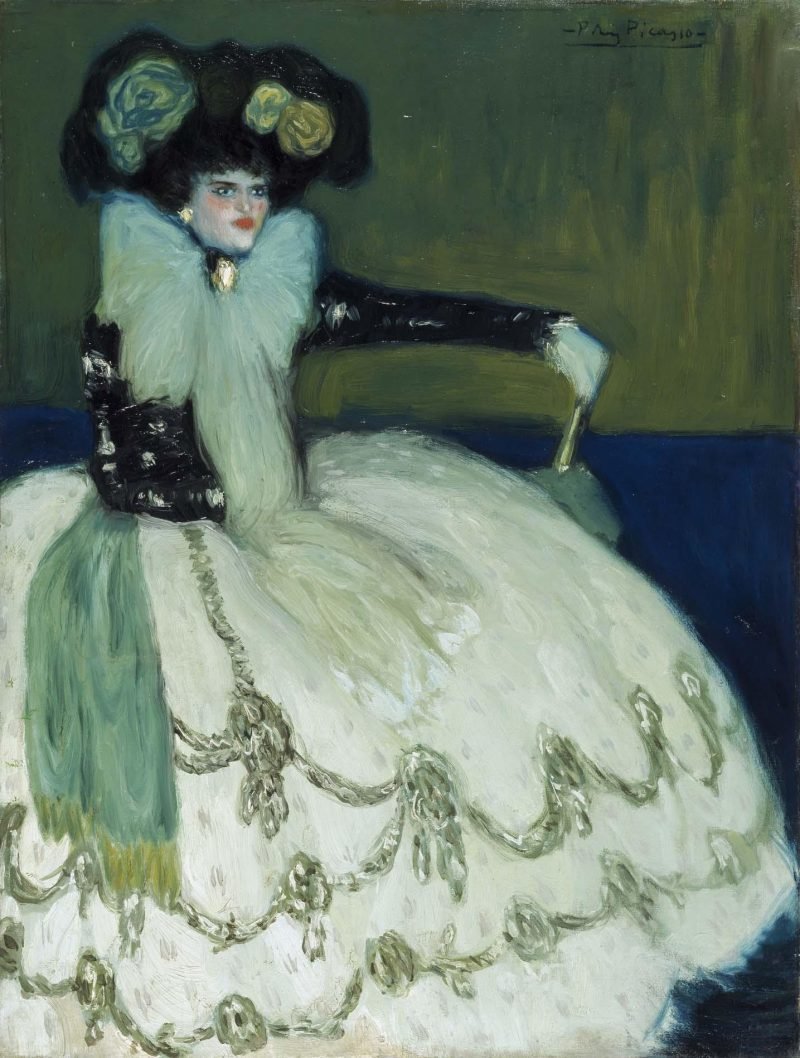
“Woman in Blue” — in Spanish, Mujer en azul — is one of Picasso’s early works and marks one of the most interesting moments in his artistic development. It was painted by the Spanish artist in 1901, when he was just 19 years old, and was presented at the General Exhibition of Fine Arts in Madrid that same year. The work is believed to have been influenced by the great tradition of Spanish court portraiture, especially Velázquez and his depictions of noblewomen at court.
The painting shows a woman with a particularly austere, almost “grumpy” attitude, yet at the same time with something theatrical and carnival-like about her: her dress appears excessively lavish, as do her elaborate hairstyle and the heavy makeup on her cheeks. The whole painting is dominated by different shades of blue, from the turquoise of the dress to the darker blues of the background.
The woman’s expression is not random either. It seems that with this portrait the artist wanted to express a sharp criticism of the hypocrisy and conformism of late-19th-century Madrid’s bourgeois society, a world from which Picasso, a young Catalan recently arrived in the capital, felt deeply alienated.
Here is an interesting curiosity about this painting.
The Woman in Blue at the Reina Sofia was one of Picasso’s most bitter disappointments: the work did not win any prize at the Madrid Exhibition and was received coldly by both the public and critics. After this failure, the young artist literally abandoned the painting in Madrid and left for Paris without worrying about it anymore. The canvas was rediscovered only in 1943, by then in very poor condition, and from that moment on it remained in Spanish state collections.
A detail you may not know: although “Woman in Blue” is often associated with Picasso’s so-called “Blue Period”, its chronological placement is actually more nuanced. The true Blue Period (1901-1904) — characterized by melancholic themes, beggars, prostitutes and marginalized figures — began in the autumn of 1901, after the suicide of his friend Carlos Casagemas. This “Woman in Blue” therefore belongs to a transitional phase, in which the young Picasso was still searching for his own artistic voice between the legacy of classical Spanish painting and the influences of Parisian modernity.
6 – Miró’s Man with a Pipe
“Man with a Pipe” — in Spanish, Hombre con pipa — is one of the works Joan Miró created during his stay in Paris in 1925, a crucial period in which the Catalan artist moved closer to the Surrealist movement led by André Breton.
You may not know this, but Miró had a real aversion to conventional painting, to the point that he openly declared he wanted to “assassinate painting”. This rebellion against academic art is very clear in this painting, where the figure is reduced to the bare minimum and almost completely stripped of detail.
The work is so barely defined that you may feel as if you are looking at a quick sketch rather than a finished painting. The figure of the man is ghostly, suspended against a neutral, almost monochrome background, completely lacking depth and somehow unsettling. You will barely recognize the pipe, a few traces of the face and features reduced to a handful of essential graphic marks.
This painting belongs to a series of canvases that scholars call “dream paintings” — in French, peintures de rêve — made by Miró between 1925 and 1927. In these works, the artist abandons any reference to visible reality in order to give voice to the unconscious, visions and hallucinations, often induced by the hunger that the young Miró was actually suffering from during those years in Paris, as he himself admitted more than once.
In short, it is a Surrealist portrait open to many different interpretations, and one that highlights all the uniqueness of Miró’s poetic universe.

7 – Le Corbusier’s The Fall of Barcelona
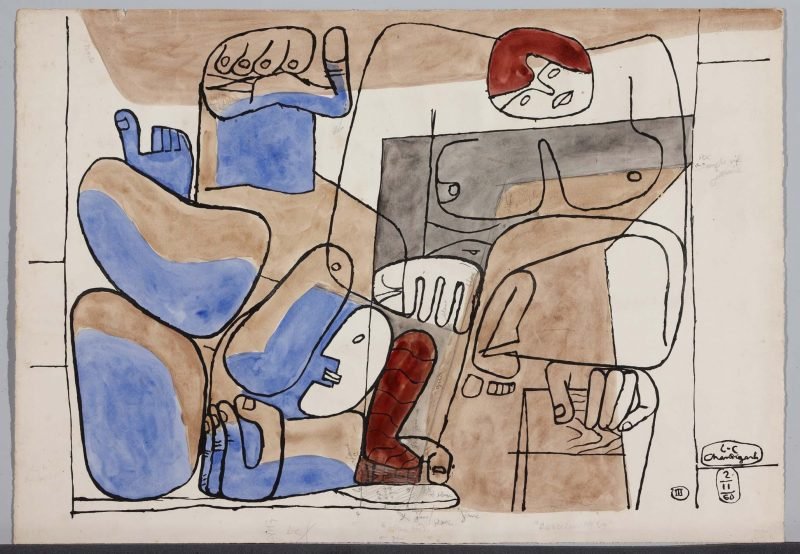
Picasso’s Guernica was not the only great work inspired by the Spanish Civil War preserved at the Reina Sofia. “The Fall of Barcelona” — in French, La Chute de Barcelone — by Le Corbusier was painted in 1939, just after news arrived that the Catalan city had fallen into the hands of Franco’s troops on January 26 of that same year.
You may not know that Le Corbusier — real name Charles-Édouard Jeanneret-Gris — was not only one of the greatest architects of the 20th century: he was also a prolific painter throughout his life. In 1918, together with the painter Amédée Ozenfant, he founded Purism, an artistic movement that reacted against Cubism by advocating a return to order, pure geometry and essential forms.
In reality, this painting is part of a whole pictorial series that Le Corbusier dedicated to the horrors of the Spanish Civil War and the suffering of the Iberian people, at the height of Franco’s repression against the Republicans.
The work powerfully highlights the destructive force of war. Its message is conveyed through the fragmentation of bodies and the breaking up of pictorial space, while fear and despair are clearly visible in the stylized faces of the figures. The palette is dominated by dark, contrasting tones, which evoke the gloomy atmosphere of the conflict.
An interesting curiosity: Le Corbusier was deeply connected to the Spanish Republican cause. He had collaborated with the government of the Second Republic on several architectural and cultural projects, and was friends with many Spanish intellectuals and artists forced into exile after Franco’s victory. His “Fall of Barcelona” is therefore not only an artistic work, but also a true political statement, an act of pictorial solidarity with defeated Spain.
8 – Gego’s Decagonal Trunk
From the museum’s more contemporary section, in the truest sense of the word, I was particularly struck by one of Gego’s creations. This Venezuelan artist of German origin created incredible geometric sculptures such as the “Tronco decagonal n.º 4” from 1979, one of the most representative works of her mature production.
Perhaps you have never heard of her, but Gego — real name Gertrud Goldschmidt, Hamburg 1912 – Caracas 1994 — is now considered one of the most important figures in Latin American kinetic and geometric art of the 20th century. Trained as an architect, she was forced to flee Nazi Germany in 1939 because of her Jewish origins and found refuge in Venezuela, the country that adopted her and where she developed her entire artistic career.
Her idea of “Dibujar sin papel” — “Drawing without paper” — is perfectly represented by this sculpture, in which space becomes the true protagonist of the work and the sculpture itself does nothing more than occupy it in “negative”.
So the sculpture is not really the metal structure created by the artist, but rather the space that is sculpted through it.
The fragility of the chosen materials — thin metal wires and stainless-steel tubes welded together to form three-dimensional grids — produces a shifting, ever-changing play of shadows, also depending on the light conditions in the room. This interaction with the surrounding space and with the viewer is an integral part of the work as well. I find it a fascinating and deeply innovative concept, one that completely overturns the traditional idea of sculpture we usually have in mind.
This work belongs to the famous “Troncos” series, geometric structures developed by Gego in the 1970s, which would later evolve into the better-known “Reticuláreas”, suspended three-dimensional networks that made the artist internationally famous.
What do you think?

9 – Propaganda and criticism of the Franco regime
All right, in this case we are not talking about a single work or a single representation, but I really loved some of the museum rooms where Francoist propaganda is placed in contrast with satire against the regime.
These satirical works were created by Republicans during the Civil War and are displayed alongside political posters from the period precisely to highlight the deep differences in political vision within Spain during those dramatic years. You will see, side by side, the official propaganda of the Nationalists, which glorified Franco as the “savior of the homeland”, and Republican posters created by artists such as Josep Renau, Manuel Monleón and other graphic artists linked to the democratic government, who instead denounced fascist violence with a strongly modern style influenced by the European avant-gardes.
The pain of a war of this kind and the terrible repression that followed its end in 1939 — Franco’s dictatorship lasted a full 36 years, until his death in 1975 — are represented through photographs, objects, drawings, newspapers and much more.
I recommend taking all the time you need to look at these documents and reflect on how fortunate we are to live in a democracy, and not under authoritarian regimes.
It is truly extraordinary to see how art is still able to make us think and send powerful messages to people, even decades later.

Practical information about the Reina Sofia in Madrid
At this point you are probably wondering how much the entrance ticket to the Reina Sofia museum costs and how to organize your visit in the best possible way.
The standard entrance ticket costs 12 euros, but the museum also offers several free-entry time slots — for example during the final hours of evening opening and on Sunday mornings — which I recommend checking on the official website before planning your visit. If you also intend to visit the Prado Museum and the Thyssen-Bornemisza, I suggest buying your ticket in advance to avoid the queues, which can be very long, especially on weekends and during high season.
In addition to the works I have mentioned, you should know that the Reina Sofia’s permanent collection is organized into three major chronological and thematic sections:
- “1900-1945. The Irruption of the 20th Century: Utopias and Conflicts” — the route begins with the historical avant-gardes of the early 20th century and continues up to the end of the Second World War.
- “1945-1968. Is the War Over? Art for a Divided World” — dedicated to the postwar period and the tensions of the Cold War.
- “1962-1982. From Revolt to Postmodernity” — from the protests of the 1960s to Spain’s democratic transition.
Since it focuses on 20th- and 21st-century art, the museum tells the recent history of Spain and Europe through the works on display. I therefore recommend visiting the Reina Sofia also as a way to deepen your knowledge of 20th-century Spanish history, from the Second Republic to the democratic transition.
How do you get to the Reina Sofia?
The museum is in an excellent location, right next to Atocha station. You can easily get there by metro, getting off at Atocha — Line 1 — or Estación del Arte — Line 1; the former “Atocha Renfe” stop was renamed precisely in honor of the museum. The exact address is Calle de Santa Isabel 52, in the central neighborhood of Lavapiés.
The only downside is that I found the exhibition route a little chaotic and not always intuitive: for this reason, I recommend downloading the museum map from the official website before your visit, or renting the audio guide available at the entrance.