Do you, like me, occasionally have a crisis when you have to pack a suitcase?
When we don’t know how to pack a suitcase we start asking ourselves “will I need the hairdryer? What is the meaning of life? Should I take shower slippers? Who am I really? And the bathrobe?”
Joking aside, I know very well that packing a suitcase is never as simple as it seems.
If you don’t know how to do it and where to put all the things you think you will need on your trip, I’ll show you what I take in mine and reveal a few tricks for saving space in your suitcase!
The first thing to do is work out whether you really need something or not. Going back to the hairdryer example: if you are staying in a hotel you probably won’t need it, because nearly all of them provide one (and even in the cheapest hostels you can borrow one at reception).
And clothes?
My advice is simple: don’t take more clothes than you will need, because you WON’T WEAR THEM.
Plan your outfit combinations if you particularly care about style, and take just one or two “wildcard” items you can use in case something gets stained or ruined on the way.
Bear in mind that in most places there are washing machines you can ask to use, or launderettes in an emergency, so there is no need to bring your entire wardrobe!
Want to find out how I pack mine?
Let’s go!

First things first: cabin bag sizes in 2026
I’m putting this part at the top because it has changed a lot since I first wrote this article, and it is the thing most likely to cost you money today.
Until a few years ago the low-cost airlines let you bring a cabin trolley on board for free. That is no longer the case: what is included in every fare is only the small bag that goes under the seat, while the proper cabin trolley almost always has to be paid for separately, with priority boarding or a supplement.
The sizes, updated to 2026, run roughly like this:
- the European Union has set a minimum standard for the free small bag, namely 40 × 30 × 15 cm, which airlines have to guarantee;
- Ryanair allows a free bag of 40 × 30 × 20 cm under the seat (a size recently increased precisely to meet the European standard);
- easyJet is more generous and includes free a small bag of up to 45 × 36 × 20 cm and 15 kg, again to be stowed under the seat in front of you.
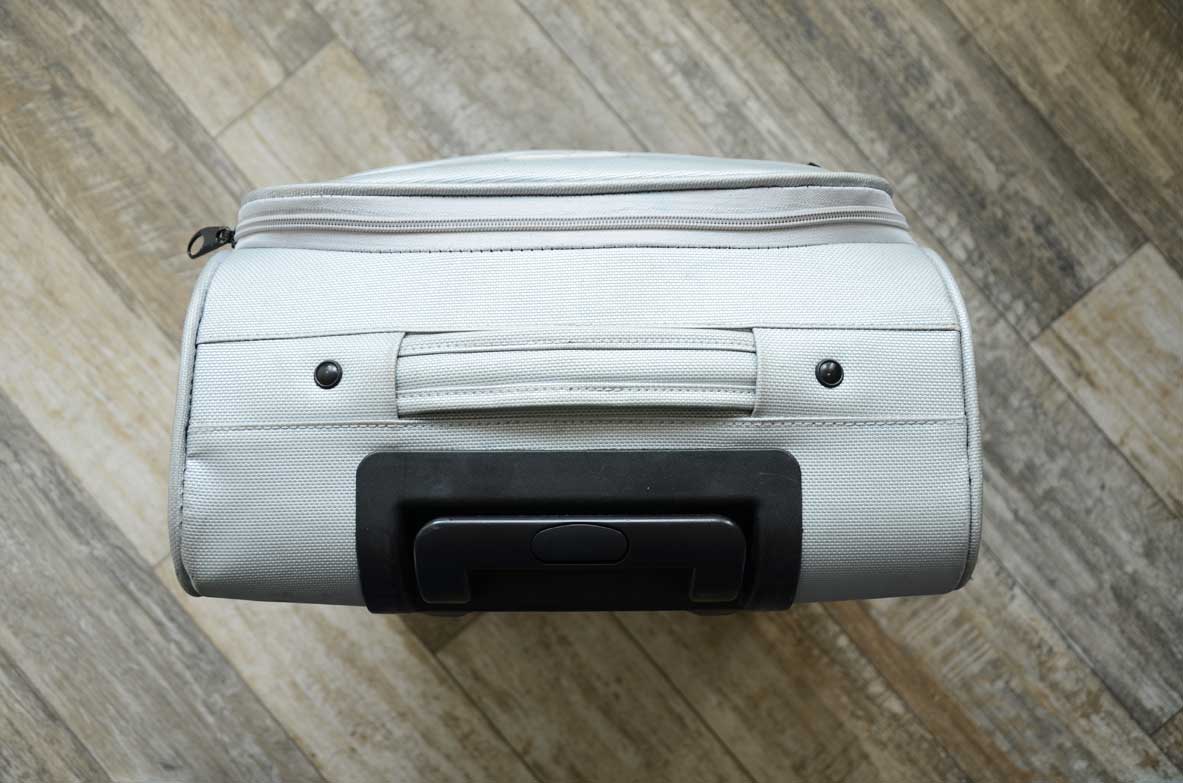
Why am I telling you this? Because the suitcase you see in these photos measures 50 × 36 × 19 cm: back then it travelled in the cabin without any trouble, but today it no longer fits within the free small bag allowance of either airline and has to be checked in or paid for as a trolley. Before buying a suitcase or booking a flight, always check the measurements on the airline’s website, because they change often and every carrier is a law unto itself.
And liquids? The rule of 100 ml per container, all inside a one-litre transparent bag, came fully back into force across the European Union in September 2024. Since 2025, however, many airports have installed new-generation scanners that let you keep liquids in your bag and, in some cases, carry up to two litres. The catch is that it depends on the individual airport and even the individual lane: the golden rule is still to pack as though the 100 ml limit always applied, so you don’t risk throwing away your shampoo at security.
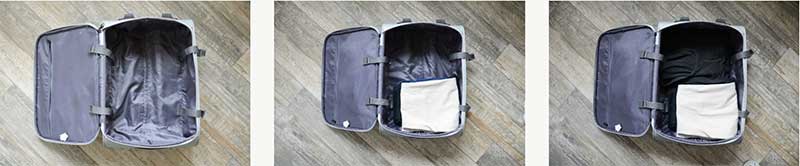
How to pack a suitcase: here’s how I do mine
I was asked some time ago to write a post on how to pack a suitcase, but it took me ages because I realised I never pack in the same way twice. It depends on where I’m going, how long I’m staying and the season. But above all it depends on the space and weight limits imposed by the transport.
To show you a “typical” suitcase I decided to make things hard for myself: I’ll pack a piece of hand luggage (so nothing checked in) for a low-cost airline.
The “trip” I imagined would last a week and I chose winter because it is the most difficult season in terms of space. Bear in mind that sometimes I take far less: it depends on the kind of trip, how often I have to move on, or whether I sleep in the same place throughout.
So do consider that this suitcase isn’t really pared down to the bare minimum. 🙂
Read on to find out what I take!
For a week in winter I take:
- 4 jumpers
- 1 oversized jumper (to wear in extreme cold under the coat and over the other jumper, worn on the day of departure)
- 5 long-sleeved tops
- 4 vest tops
- 4 pairs of trousers
- one skirt
- one heavy dress
- 1 pair of pyjamas
- 7 pairs of pants
- 7 pairs of socks
- 3 pairs of leggings or thick tights (to wear under the dress, the skirt or even under trousers if it is cold)
- 2 bras
- 2 large microfibre towels
- 1 pair of boots (worn on departure)
- 1 pair of trainers
- 1 pair of flip-flops
- 1 small wash bag with the essentials (medicines included)
- the laptop and a book
- 1 bag for dirty clothes on the way home
- a coat
- a scarf
- a hat
- a pair of gloves
- chargers
- wallet
- phone
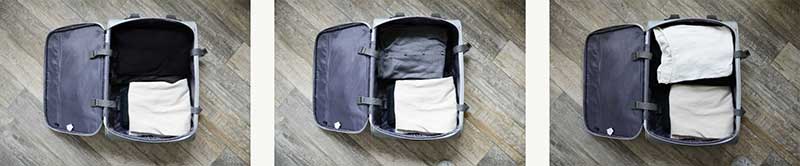
The 5 tricks for saving space
I have already told you what I think is essential to carry in your hand luggage. In this case our suitcase is also the hand luggage, so the 8 things to keep in your hand luggage went into the suitcase.
I didn’t apply all 5 space-saving packing tips I’m about to give you, because there was no need. Either way, I hope they come in useful!
Here are my tips:
- Vacuum bags: if you have to take a lot of bulky garments, my advice is to seal them in vacuum bags. They may crease but they will take up a third of the space. Watch out for one thing few people mention: vacuum bags compress volume but don’t remove a single gram of weight, so if your constraint is weight rather than space, they are of no use at all.
- Roll instead of folding: soft items such as tops, vests and pyjamas take up less room and crease less if you roll them tightly rather than folding them. Stiff, structured items like shirts and jackets are better folded. If you then stand the rolls upright, side by side, you can see everything at a glance without unpacking every time.
- Fill the gaps: socks, chargers, even shoes (if separated into two different bags) are perfect for filling the “holes” left by clothes. Socks rolled up inside shoes are the classic that always works.
- Wear the bulkiest items: always wear your most voluminous clothes. Boots, heavy shoes, thick jumpers and coat, if you are short of space, go on your body at departure.
- Travel sizes: small soaps, little bottles to fill with your own products, small combs, microfibre towels. Take the things that occupy least space, and remember that liquid bottles must be no more than 100 ml if you are travelling with hand luggage only.
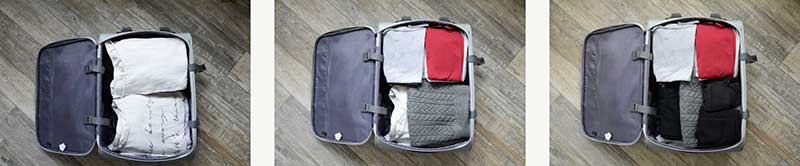
How I organise things, in practice
When I’m about to leave, to work out what to take I lay all the clothes out on a table. That way I get an idea of how much I’m about to carry, what is missing and what I might need (or leave at home).
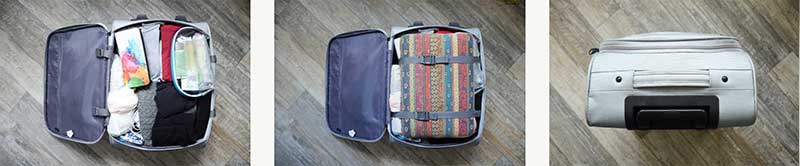
I put underwear in a clean pouch in the pocket on the inside of the suitcase lid, together with socks in another bag. As slippers I only ever take waterproof flip-flops, which I seal in a bag with the soles facing each other. If I decide to take a second pair of shoes, I separate them and seal them in two different bags to slot in as “gap fillers” around the suitcase.
In the outside pocket of the bag I always keep documents in a plastic pouch, tissues, a book or e-reader and my phone, unless I have a small handbag with me. Electronics such as the laptop always travel in a padded case made for the purpose, which protects them from knocks. Sometimes, to protect them further, I slide them between the layers of clothes. If you are flying, remember that power banks must always go in your hand luggage and never in the hold: air safety rules forbid it.

I’ll write a dedicated post about the wash bag soon.
If I have to take my own towels, when I’m staying in a hostel or with friends, I always take two large microfibre ones, one for the body and one for the face. Microfibre may not be the nicest thing against the skin, but it takes up hardly any space, dries at once and is very practical. I keep those two towels in one or two clean bags along with the underwear, or as “gap fillers”.
There is one other thing I never leave at home: a swimming costume. There are two reasons:
- I’m water-addicted: the moment I see a pool, a river, a puddle, I literally dive in;
- I don’t know why, but every time I haven’t taken one I have ended up having to buy one for the lake, the thermal baths or the spa, and by now I never leave without it, not even for a weekend. 🙂
A small provocation
There is one thing I can’t understand: why do some people want to bring all the comforts of home with them when they travel? You are TRAVELLING, not at home! So dust off your sense of adaptability and your flexibility.
To hell with shower slippers and bedroom slippers, beach sliders and posh sandals.
Get out the ugly plastic flip-flops from the swimming pool and use only those for everything, including swimming in the sea and going for walks! Step out of your comfort zone, test yourself even on the smallest things: giving up some pointless comfort might make you discover things about yourself you never imagined. This too is a way of pushing past your own limits. 😉

Packing a suitcase is like playing Tetris: a job of slotting things together and selecting. The important thing is not to lose your calm and to find out properly what there is and isn’t at the other end. If you are going to a hotel that provides towels and a hairdryer, slippers and shampoo, there will be no need to bring your own.
One last suggestion, if you like methods: some people swear by vertical folding in the Marie Kondo style, standing folded items upright like files rather than stacking them, so you can see everything without dismantling the suitcase. Try it, but without obsessing: the perfect suitcase doesn’t exist, only the one that closes.
Once you have learned to fit everything in your suitcase, the next step is asking how to cut the impact of your trip: here are my ideas for eco-friendly travel.
And you, are you a roller or a folder? What is the space-saving trick you never betray?