
Sainte Chapelle is a gothic masterpiece created by Saint Louis IX to contain the most precious relics of Christendom.
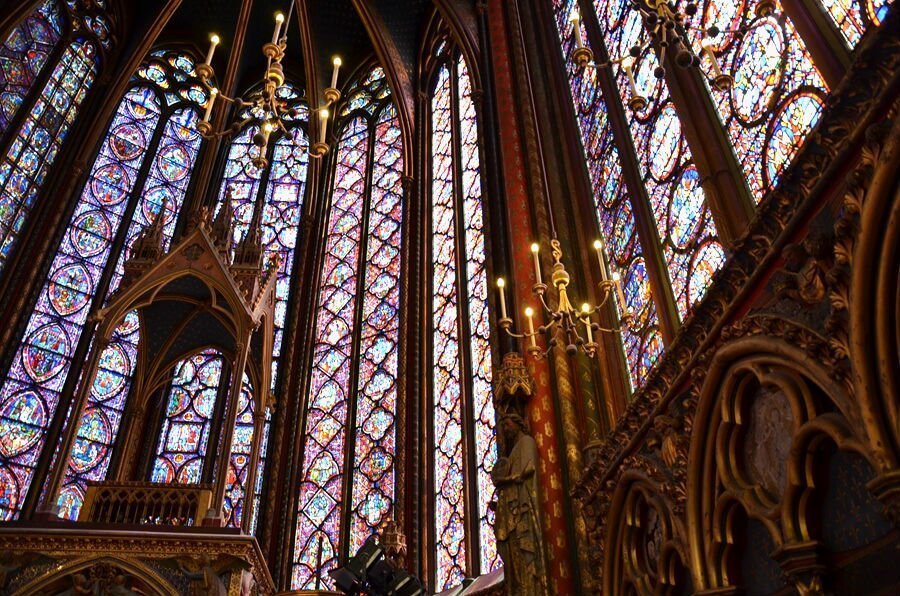
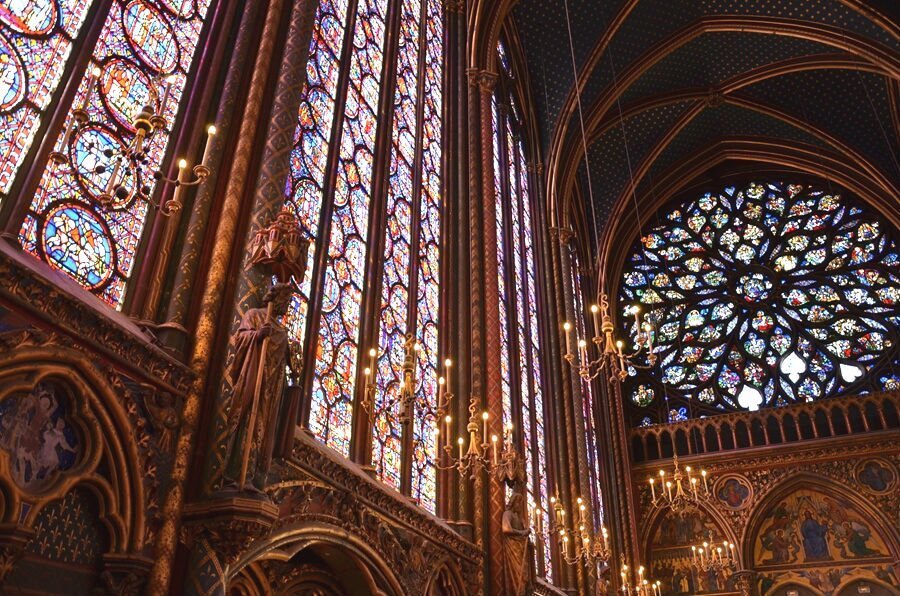
It is one of the most beautiful attractions in Paris that will leave you speechless for the beauty of its windows and its light.
The history of the Sainte Chapelle: a coffer of relics
Of my previous visit in 2007, one of the monuments that had struck me most in Paris was the splendid Sainte Chapelle, the palatine chapel of King Louis IX, also known as Louis the Saint.
It was built between 1242 and 1248 to contain the relics of the crown of thorns of Jesus, collected by the pious sovereign. It was united with the royal palace and is now incorporated into the Paris Courthouse (Palais de Justice).
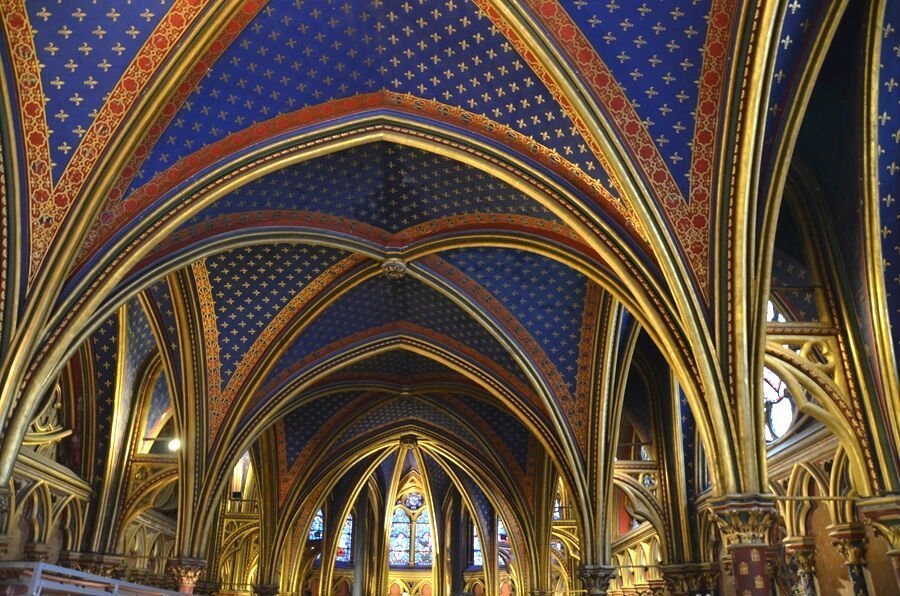
The king, who paid a very high price for the relics, had built this splendid chapel on two levels: the lower one is architecturally simpler, while the upper chapel is one of the most beautiful Gothic masterpieces in France.
The political message of the Sainte Chapelle
The political purpose of this construction was to establish Paris as a major Christian center, opposing Constantinople, from whom he bought the precious crown of thorns at a high price from Emperor Baldwin II.
Probably the architect was Pierre Montreuil (although it is not attested in any document), who had also worked in Saint Denis and the facade of Notre Dame.

The miraculous rescue of the Sainte Chapelle windows
It is by pure chance that the windows of the Sainte Chapelle in Paris are in good condition. In fact, the French revolution caused the destruction of many religious works, above all in Paris. Fortunately, the windows of the Sainte Chapelle were covered and therefore were not damaged in contrast to those of many other churches.
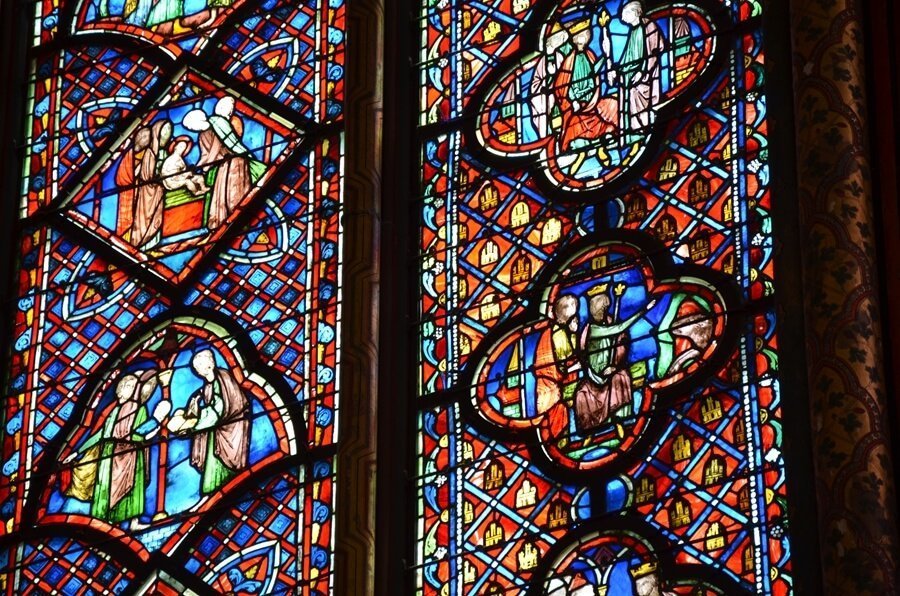
About 60% of the windows are original and tell biblical stories. It starts from the Genesis (first stained glass on the left of the altar) to finish with the apocalypse of John (in the rose window that however is later).
There is also narrated the story of the discovery of relics by the mother of the first Christian emperor Constantine, Saint Helena and the construction of the Sainte Chapelle itself.
Blanche of Castile: one of the greatest women of the Middle Ages
The Sainte Chapelle was built by Louis the Saint but this project is also due to his mother, Blanche of Castile. She was an extraordinary woman, intelligent and cultured, among the most important medieval queens. Not only did she raise more than ten children, but she managed to keep the regency of the French state for many years.
When she was a widow, her son Louis was crowned at 12 years old. Her position was very critical, being a foreigner and a widow but facing the host of the barons alone, who wanted to seize power by climbing over the young king.
Blanche of Castile was able to maintain the reign intact until her child’s majority thanks to her diplomacy and her political skills.

Symbology and numerology in the Sainte Chapelle
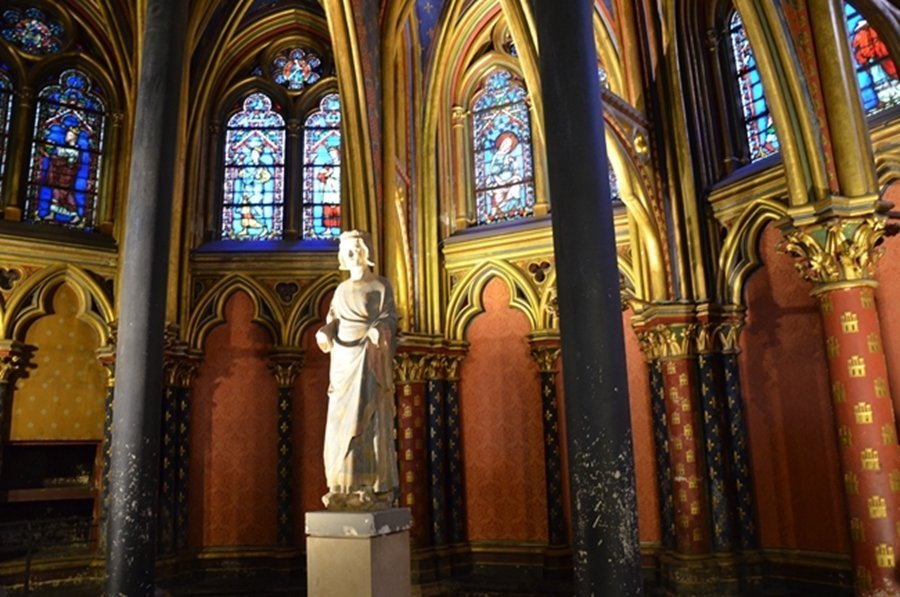
An interesting detail to understand the king’s personality are the symbols of the lily and the castle on the columns. The lily, symbol of the French rulers, represents the father of Louis IX, while the castle is the emblem of the Castilian family to which the mother Blanche belonged.
The construction of this chapel follows a precise symbolic and numerological scheme.
In fact, the length from the apse to the upper portico measures 100 feet as in the Old Testament it is written that the temple of Solomon (the just king par excellence) was 100 cubits.
In addition, the external chorus counterparts were compared with the internal ones: the relationship is 50:30 with a ratio of 1.6, the golden number.
The golden section was widely used in ancient art and medieval art such as in Castel del Monte.
Among other things, the apse of the Sainte Chapelle is made up of half a dodecagon, a number that obviously refers to the Holy Apostles.
The number seven of the sides of the choir would instead be a reference to the apocalypse or to the creation of the world.

La Sainte Chapelle today
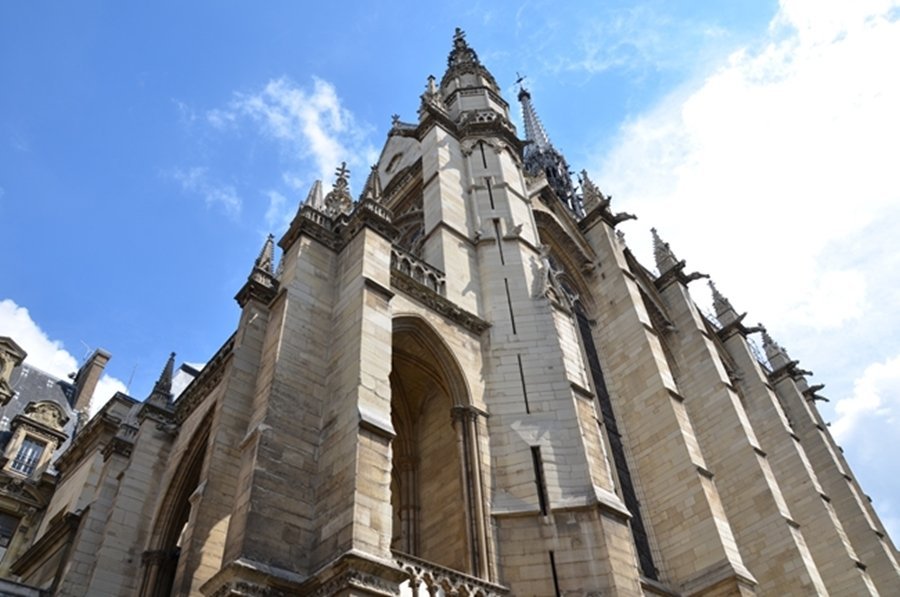
The current spire is huge and completely lined with lead. It was commissioned by Viollet-le-Duc in the 19th century and is therefore not original (like the choir stalls).
Today the Sainte Chapelle is still consecrated and remains a Catholic church.
The relics that were kept there were transferred to Notre Dame. Nevertheless it maintains its charm of precious sacred coffer: the light that filters through the windows, the colors and the majesty of the structure that seems to stand on its feet miraculously, leave me breathless.
It is perhaps the monument of Paris that I love most. The thrill of entering it is always very strong and I am sure it can not leave anyone indifferent.
Entrance ticket Sainte Chapelle
Being a national monument, the ticket price for Sainte Chapelle is 22€ for adults (non-EU residents), 16€ for EU residents, free under 18 years. The photos can not describe the thrill of visiting it, but I hope they can give you an idea of its beauty!
